
Category: Basics

  • When to Order Football Uniforms (and 7v7): A Backwards Timeline for US Teams

    When to Order Football Uniforms (and 7v7): A Backwards Timeline for US Teams

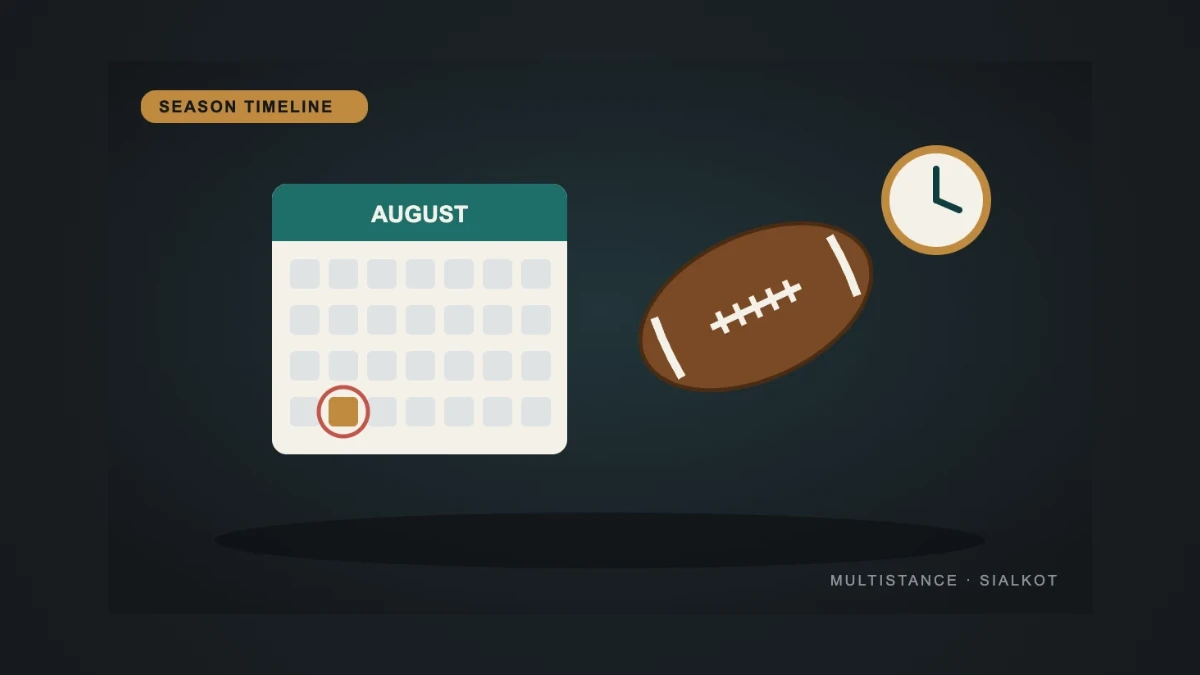
    Short answer: when to order football uniforms depends on your first game. For a late-August kickoff, start design in the winter, approve your sample by spring and confirm the order by about May. Plan backwards from the date you need the kit in hand — not the dispatch date — and leave a buffer for roster changes and shipping.

    Custom sublimated or tackle-twill uniforms made overseas, for example in Sialkot, Pakistan, go through design, quote, sample, approval, production and shipping. Each step takes its own time, and most delays come from the steps on the buyer’s side: late artwork, late rosters and late approvals. Here is a calendar that works.

    When to order football uniforms: month-by-month plan

    WhenWhat you doWhy
    December – FebruaryAgree colours, logo files and the design brief; decide pieces per set (jersey, pants, socks, practice gear)Design rounds take longer than anyone expects
    MarchRequest quotes; compare fabric, decoration and shipping termsGives time to compare suppliers properly
    AprilOrder and check a pre-production sample; confirm the size chartSizing problems are cheap to fix now, expensive later
    By early MayApprove final artwork, sizes and roster; make the first paymentProduction starts only after written approval
    May – JulyProduction, inspection, packing and shippingTrack each stage instead of chasing by email
    Early AugustKit in hand, two to three weeks before the first gameTime for photo day, late players and fixes

    Your manufacturer confirms production time in the quote; at Multistance we plan backwards from the date you need the kit. See how our timeline planning works.

    7v7: plan for a spring and summer season

    Most 7v7 tournaments run from late winter through summer. For a March or April start, finalize designs in the autumn before and approve the order by early January. Teams travelling to summer tournaments should order a second set or spares at the same time, because small add-on orders shipped later cost more per piece. Browse our 7v7 uniforms.

    The five things that cause late uniforms

    1. Artwork sent as low-resolution images instead of vector files.
    2. The roster (names, numbers and sizes) changes after cutting starts.
    3. No sample — and the size chart does not match what players expect.
    4. The order is approved too close to the season, so rush shipping is the only option.
    5. Duties and customs were not planned, so the shipment waits at the border.

    Roster and sizing tips

    • Collect sizes with a fitting set or the manufacturer’s size chart — not by guessing from another brand.
    • Add 5–10% extra pieces in common sizes for new players during the season.
    • Lock names and numbers in one signed-off spreadsheet.
    • Decide packing in advance: by size, or by player name.

    Importing for the first time? Read importing custom uniforms from Pakistan to the USA before you order.

    Already late? What to do if your season starts soon

    If you are reading this in June and still have no order, it is not too late to get kit for the first game, but you need to cut decisions, not corners. Teams that recover a late order usually do four things:

    1. Keep the design simple. Reuse last season’s artwork or pick a proven template instead of starting from scratch.
    2. Send everything at once. Vector logo, colours, the full roster with names, numbers and sizes, and the delivery address in one email.
    3. Approve within a day. Each day a quote or sample waits for a reply is a day lost from production.
    4. Prioritise game jerseys. Order game uniforms first and add practice gear, warm-ups and spares in a second shipment.

    Tell your manufacturer the exact date you need the kit in hand. A good factory will say honestly whether the date is realistic before you pay anything.

    Frequently asked questions

    Not sure when to order football uniforms? Tell us your first game date and request a quote, or see custom team uniforms for US teams and American football uniforms.
  • Milestone Payments vs 100% Upfront: How to Pay an Overseas Uniform Manufacturer Safely

    Milestone Payments vs 100% Upfront: How to Pay an Overseas Uniform Manufacturer Safely

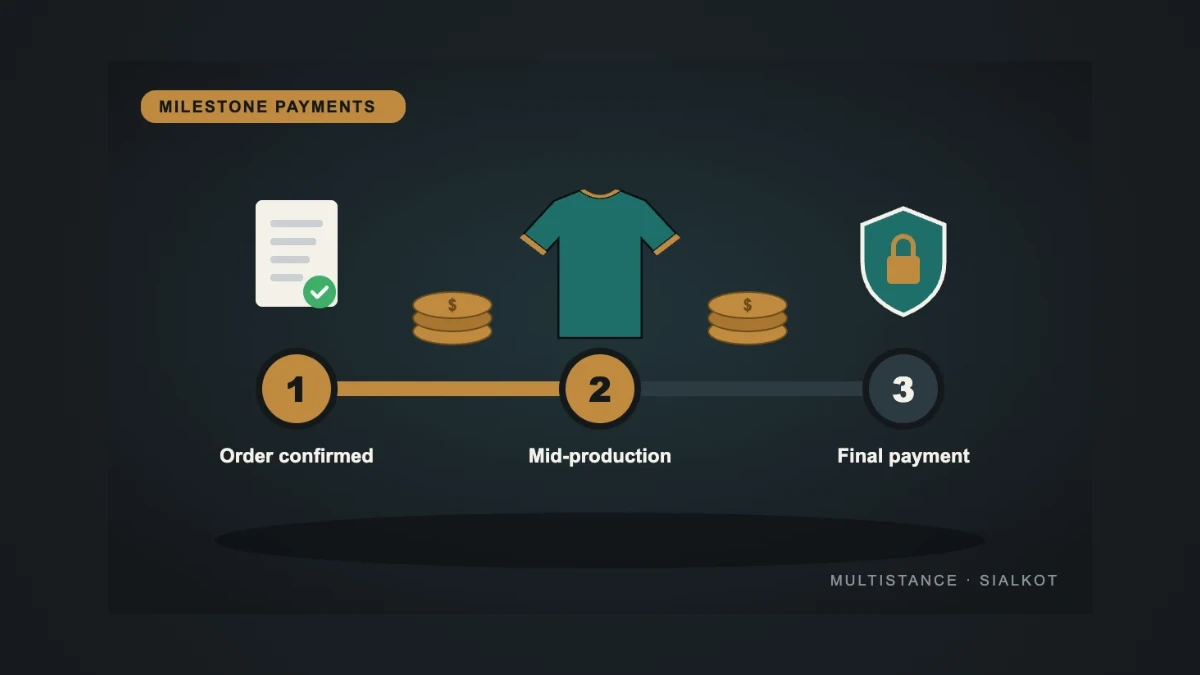
    Short answer: for most team and brand orders, milestone payments — payments tied to verified production stages — are the safest middle ground. You never pay for work you cannot see, and the factory is funded for materials. 100% upfront puts all the risk on you; letters of credit give strong protection but cost more and suit larger orders.

    When you order sportswear from a manufacturer in Sialkot, Pakistan — or anywhere overseas — the payment terms matter as much as the price. This guide compares the common options and explains how milestone payments work in practice.

    The common payment terms compared

    Payment termHow it worksBuyer riskBest for
    100% upfrontFull payment before productionHigh — you have paid before seeing anythingSamples and very small orders only
    Deposit + balanceA deposit to start, the balance before shippingMedium — you see little until the balance is dueRepeat orders with a supplier you trust
    Milestone paymentsPayments released at defined production stages, with proof at each stageLow to medium — each payment follows visible progressFirst orders, team kits, new brands
    Letter of credit (LC)Your bank pays when shipping documents match the termsLow — but bank fees and paperworkLarge commercial orders
    Platform escrowA marketplace holds funds until deliveryLow — but platform fees and rulesOrders placed through a marketplace

    For how letters of credit work in detail, see the US International Trade Administration’s letter of credit guide.

    Why milestone payments work for both sides

    The factory needs money to buy fabric and trims; you need proof that your order is real before paying more. Milestones solve both. Each payment is linked to a stage you can check — an approved specification, photos from the production line, an inspection report — so your money follows the work.

    How milestone payments work at Multistance: 3 checkpoints

    1. First payment — order confirmed. You approve the quote, artwork, sizes and roster in writing, then make the first payment. Production starts after this.
    2. Mid-production payment — during stitching. By now fabric has been inspected, panels cut and logos applied, all visible in your buyer portal.
    3. Final payment — after inspection and packing. You review the final inspection summary. The tracking number is released once the final payment is received.

    The amount of each payment is set in your quote, and every checkpoint has its own invoice. This is our internal payment process, not a regulated escrow service. See the full transparency system and the 10 production stages.

    Safe ways to send the money

    • Bank transfer (SWIFT) — best for larger payments.
    • Wise or Payoneer — pay into local USD, GBP or EUR details, usually with lower fees.
    • Card via Stripe — a secure payment link, good for samples and small orders.
    • Western Union or MoneyGram — available on request for sample payments.

    Whatever method you use, pay an account in the company’s name, and confirm any change of bank details by phone or video call — never by email alone.

    Questions to ask before you pay

    • What exactly triggers each payment?
    • What proof will I see at each stage — photos, reports, documents?
    • What happens if a defect is found at final inspection?
    • Which account will I pay, and is it in the company’s name?
    • When will I receive the tracking number and shipping documents?

    Frequently asked questions

    Is it safe to pay a manufacturer in Pakistan upfront?

    Paying 100% upfront puts all the risk on the buyer. For first orders, payments linked to visible production stages are safer.

    What are milestone payments?

    Milestone payments are released when a defined stage of production is complete and you can see proof of it, such as an approved specification, production photos or an inspection report.

    How does Multistance split payments?

    Into three checkpoints: a first payment at order confirmation, a mid-production payment during stitching and a final payment after inspection and packing. The amounts are set in your quote.

    Is Multistance’s payment process an escrow service?

    No. It is our internal payment process, with an invoice for each checkpoint and progress shown in your buyer portal. It is not a regulated escrow service.

    Which payment methods are accepted?

    Bank transfer (SWIFT), Wise, Payoneer and card via Stripe. Western Union and MoneyGram are available on request for samples.

    Questions about payment terms? Book a call or request a quote to see the checkpoints for your order.

  • What MOQ Actually Means for New Brands

    A manufacturer’s minimum order quantity isn’t an arbitrary gatekeeping number — it usually reflects a real constraint, like a minimum fabric roll length, a minimum efficient run on a particular machine, or a per-style setup cost that only makes sense above a certain volume.

    That means MOQ should vary by product, not be quoted as a single company-wide figure. A simple single-color tee has a very different minimum than a multi-panel, multi-color combat sports garment with custom trims.

    If a manufacturer quotes one flat MOQ for everything they make, it’s worth asking what’s actually driving that number for your specific product — the answer tells you whether it’s a real constraint or a soft preference for larger customers.

    For new brands, the more useful question is often: what’s the minimum for exactly what I want to build, and why?

    Have a sourcing question? Ask us or book a call.

  • OEM vs. Private Label, Explained

    The two terms get used loosely, but the practical difference is straightforward. OEM manufacturing means building a product to your specification — your tech pack, your materials, your construction requirements — regardless of whose label ends up on it.

    Private label typically starts from a proven, existing construction and adds your branding: your label, your hangtag, your packaging. It’s often a faster and lower-risk path for a new brand that doesn’t yet have a fully developed tech pack.

    Neither model is inherently better — the right choice depends on how much control you need over construction versus how quickly you need to get to market. Many brands start private label for their first collection and move toward OEM as their specifications mature.

    What shouldn’t change between the two is the discipline behind the order: the same documented process, inspection stages, and payment structure should apply either way.

    Have a sourcing question? Ask us or book a call.