Author: husnainmsi

  • UK Club Kits From Pakistan: Timeline, Duty and VAT Guide

    UK Club Kits From Pakistan: Timeline, Duty and VAT Guide

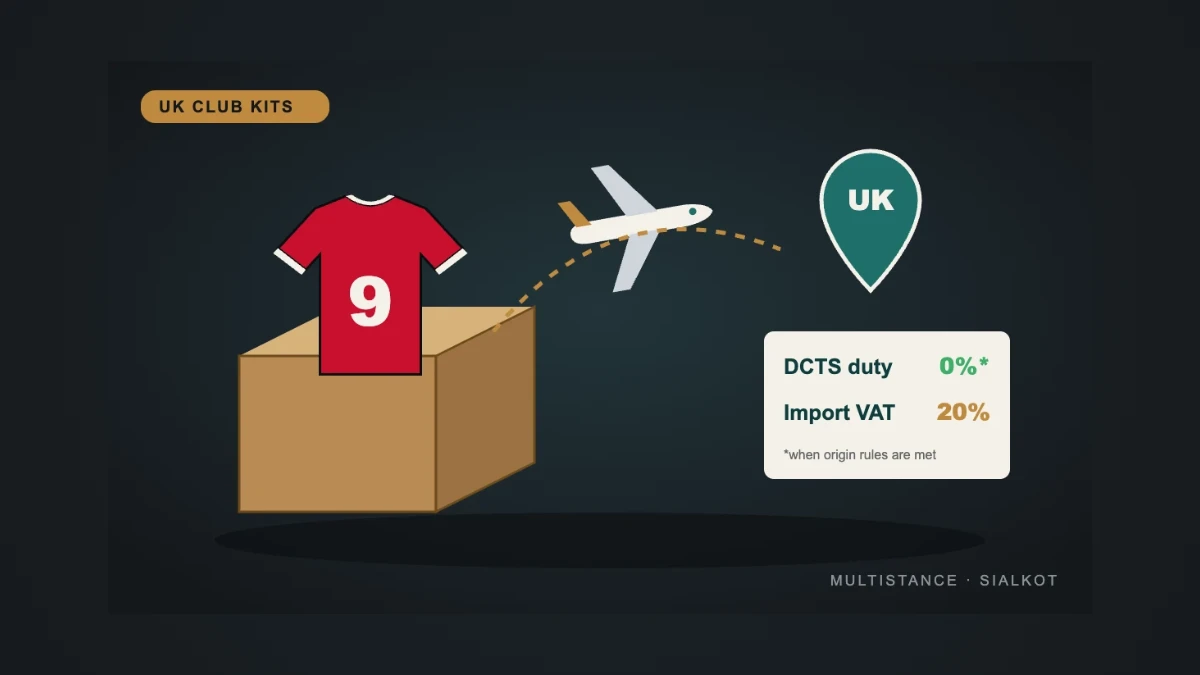
    Short answer: UK club kits made in Sialkot, Pakistan should be designed and approved by spring for an August season start. Pakistan is in the top tier of the UK’s Developing Countries Trading Scheme (DCTS), so most clothing can enter at 0% customs duty when the origin rules are met and the preference is claimed. Import VAT at 20% still applies.

    Sialkot has supplied football and rugby kit to UK clubs and brands for decades. This guide covers the season timeline, duty and VAT, and the paperwork, so your kit lands before the first fixture.

    Season timeline for UK club kits

    WhenWhat you do
    January – FebruaryAgree the design, sponsor logos and pieces per player (shirt, shorts, socks, training wear)
    MarchRequest quotes and order a sample; collect sizes with a size chart
    AprilApprove the sample, final artwork and the squad list with names and numbers
    May – JuneProduction, inspection, packing and shipping
    JulyKit in hand for pre-season friendlies and photos

    Netball clubs on an autumn league start can follow the same plan. Your manufacturer confirms production time in the quote; we plan backwards from the date you need the kit. See how an order works.

    Duty on UK club kits: how DCTS helps

    The UK’s Developing Countries Trading Scheme replaced the old GSP in 2023. Pakistan is in the Enhanced Preferences tier, which removes duty on the large majority of product lines. Without a preference, clothing usually pays the UK Global Tariff rate, which for many garments is up to 12%.

    To get the preference:

    • The goods must meet the DCTS rules of origin — kit cut and sewn in Pakistan normally qualifies, but check your commodity code.
    • The exporter provides proof of origin, such as an origin statement on the invoice.
    • The UK importer (you, or your courier acting for you) claims the preference at import.

    Look up your commodity code on the UK Trade Tariff and select Pakistan as the country of origin to see the preferential rate.

    VAT and other charges

    • Import VAT at 20% applies to the value of the goods plus shipping and any duty. VAT-registered clubs and businesses can usually reclaim it.
    • Courier clearance fees may be charged when the courier pays VAT on your behalf.
    • Ask whether the quote is DAP (you pay VAT and any duty on arrival) or DDP (the seller pays them).

    Paperwork

    • Commercial invoice with a clear product description, fibre content, value and origin: Pakistan.
    • Origin statement for the DCTS preference.
    • Packing list and the air waybill or bill of lading.

    Multistance prepares these documents at dispatch and stores them in your buyer portal. See our teamwear manufacturer for UK clubs page.

    Frequently asked questions

    Do UK clubs pay import duty on kit from Pakistan?

    Often not. Pakistan is in the DCTS Enhanced Preferences tier, so most clothing can enter at 0% duty when the rules of origin are met and the preference is claimed. Check your commodity code on the UK Trade Tariff.

    Do I pay VAT on imported kit?

    Yes. Import VAT at 20% applies. VAT-registered clubs and businesses can usually reclaim it.

    When should UK club kits be ordered for the new season?

    Approve the sample, artwork and squad list by about April so the kit arrives in July, before pre-season.

    What is DCTS?

    The UK Developing Countries Trading Scheme, which gives reduced or zero tariffs on imports from eligible developing countries, including Pakistan.

    Can I order rugby and netball kit too?

    Yes. Multistance makes custom football, rugby and netball kit, training wear and accessories.

    Kitting out your club? Browse football kits, rugby kit and netball dresses, or request a quote.

    Checked 9 November 2026. Sources: GOV.UK on DCTS and Pakistan, DCTS Enhanced Preferences summary. General information, not customs or tax advice.
  • How Much Do Custom Team Uniforms From Pakistan Cost? A Landed-Cost Guide for US Teams

    How Much Do Custom Team Uniforms From Pakistan Cost? A Landed-Cost Guide for US Teams

    Short answer: the cost of custom team uniforms from Pakistan depends on five things — fabric, decoration method, how many pieces are in each set, order size and how the order is shipped. The factory price is only part of it: US teams should budget for shipping, US import duty and the 10% Section 301 tariff that has applied to Pakistani goods since July 2026.

    Most custom teamwear sold in the US by sports brands and team dealers is made in a handful of countries, and Sialkot in Pakistan is one of the largest centres for it. Buying direct from a Sialkot manufacturer like Multistance International removes the middle layers, but it also means you see every cost line yourself. This guide explains each one so you can compare quotes properly.

    What drives the factory price of custom team uniforms

    Cost driverWhat changes the priceWhat to ask the factory
    FabricWeight (GSM), stretch, mesh vs. interlock, moisture-wicking finishWhich fabric and GSM is quoted, and can I see a swatch?
    DecorationFull sublimation, tackle twill, screen print, embroidery or a mixIs the price per colour, per location or all-inclusive?
    Pieces per setJersey only, jersey + shorts or pants, socks, warm-upsIs the quote per piece or per full set?
    PersonalisationPlayer names and numbers on each garmentAre names and numbers included, and on which locations?
    Order sizeLarger runs spread setup work across more piecesHow does the unit price change if I add players or a second kit?
    PackagingBulk packing, polybag per piece, packing by player nameIs packing by player name included?

    Full sublimation usually gives the most design freedom for the price, because colours and graphics are dyed into the fabric in one step. Tackle twill and embroidery look more traditional for American football, baseball and basketball, but each extra layer adds labour. Our guide to how an order works shows where each step happens.

    From factory price to landed cost

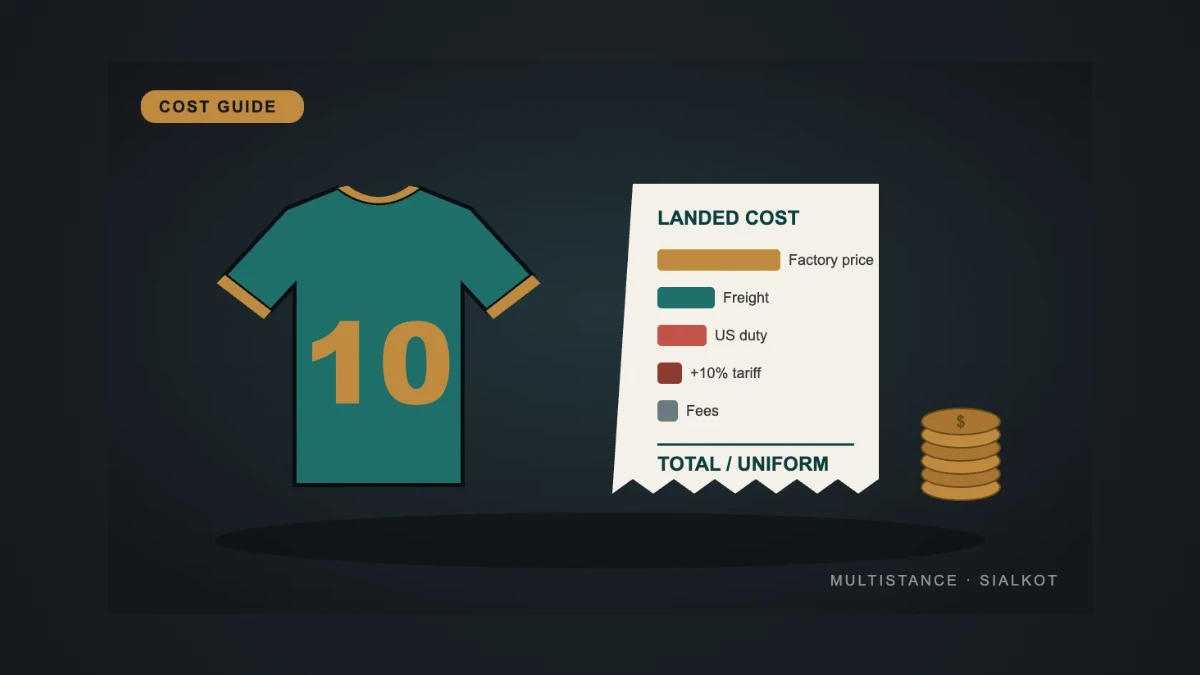
    The landed cost is what your custom team uniforms really cost once it is at your door in the US. Work it out like this:

    1. Factory price for the uniforms, as quoted.
    2. Sample cost, if you order a pre-production sample.
    3. Freight — air express (fastest, best for most team orders) or sea freight (cheaper per kilo for large orders, but slower).
    4. US import duty — the normal rate for your product’s HTS code. For synthetic sportswear this varies by garment and fabric, and some knit tops are as high as 32%.
    5. Section 301 tariff — an extra 10% on goods from Pakistan since 24 July 2026, added on top of the normal duty.
    6. Customs clearance and broker fees — charged by the courier or your customs broker.
    7. Payment fees — bank wire, Wise or card fees.

    Since August 2025 the US $800 duty-free (de minimis) allowance has been suspended for all countries, so every shipment pays duty, even a small sample. Check the duty rate for your exact product code with your courier or a customs broker before you order; our Incoterms guide explains who pays which costs.

    Hidden costs that catch teams out

    • Late roster changes after cutting starts — extra names or sizes may need a separate small run.
    • Rush shipping because the order was placed too close to the season.
    • Duties and clearance fees billed by the courier on arrival when the quote was ex-works.
    • Re-orders for new players mid-season, shipped on their own.

    Each of these is avoidable with a written specification, a confirmed roster and a realistic timeline before production starts.

    How to compare custom team uniforms quotes fairly

    Put every quote into the same table: fabric and GSM, decoration method, pieces per set, names and numbers included or not, sample cost, shipping method and who pays duties. A lower unit price that excludes names and numbers, or quotes a lighter fabric, is not cheaper. Ask each supplier to quote the same specification.

    At Multistance we send an itemized quote with these lines spelled out, and payment is split into three checkpoints linked to production stages rather than one large upfront transfer. You can follow every stage in your buyer portal — see how our transparency system works.

    Frequently asked questions

    Is it cheaper to make custom team uniforms in Pakistan than in the US?

    Factory prices in Sialkot are usually lower than domestic US production, but compare landed cost, not unit price. Add freight, the normal US duty, the 10% Section 301 tariff on Pakistani goods and clearance fees before deciding.

    Do I have to pay duty on a small order or a sample?

    Yes. The US suspended the $800 de minimis duty-free allowance for all countries in August 2025, so small shipments and samples are now dutiable.

    What is the minimum order for custom uniforms?

    At Multistance there is no fixed minimum order. Quantities are agreed for each order, and your quote confirms them in writing.

    What decoration method gives the best value?

    For most team sports, full sublimation offers the most colours and graphics for the price. Tackle twill and embroidery suit a classic look but add labour per layer.

    How do I get an exact price?

    Send your sport, number of players, pieces per set and design idea through our quote form. You receive an itemized quote.

    Ready to price your kit? Request a quote, explore our custom team uniforms for US teams or browse American football uniforms.

    Tariff information checked 9 November 2026. Sources: Section 301 forced-labor tariffs, de minimis suspension. Tariffs change often; confirm with your customs broker.

  • When to Order Football Uniforms (and 7v7): A Backwards Timeline for US Teams

    When to Order Football Uniforms (and 7v7): A Backwards Timeline for US Teams

    Short answer: when to order football uniforms depends on your first game. For a late-August kickoff, start design in the winter, approve your sample by spring and confirm the order by about May. Plan backwards from the date you need the kit in hand — not the dispatch date — and leave a buffer for roster changes and shipping.

    Custom sublimated or tackle-twill uniforms made overseas, for example in Sialkot, Pakistan, go through design, quote, sample, approval, production and shipping. Each step takes its own time, and most delays come from the steps on the buyer’s side: late artwork, late rosters and late approvals. Here is a calendar that works.

    When to order football uniforms: month-by-month plan

    WhenWhat you doWhy
    December – FebruaryAgree colours, logo files and the design brief; decide pieces per set (jersey, pants, socks, practice gear)Design rounds take longer than anyone expects
    MarchRequest quotes; compare fabric, decoration and shipping termsGives time to compare suppliers properly
    AprilOrder and check a pre-production sample; confirm the size chartSizing problems are cheap to fix now, expensive later
    By early MayApprove final artwork, sizes and roster; make the first paymentProduction starts only after written approval
    May – JulyProduction, inspection, packing and shippingTrack each stage instead of chasing by email
    Early AugustKit in hand, two to three weeks before the first gameTime for photo day, late players and fixes

    Your manufacturer confirms production time in the quote; at Multistance we plan backwards from the date you need the kit. See how our timeline planning works.

    7v7: plan for a spring and summer season

    Most 7v7 tournaments run from late winter through summer. For a March or April start, finalize designs in the autumn before and approve the order by early January. Teams travelling to summer tournaments should order a second set or spares at the same time, because small add-on orders shipped later cost more per piece. Browse our 7v7 uniforms.

    The five things that cause late uniforms

    1. Artwork sent as low-resolution images instead of vector files.
    2. The roster (names, numbers and sizes) changes after cutting starts.
    3. No sample — and the size chart does not match what players expect.
    4. The order is approved too close to the season, so rush shipping is the only option.
    5. Duties and customs were not planned, so the shipment waits at the border.

    Roster and sizing tips

    • Collect sizes with a fitting set or the manufacturer’s size chart — not by guessing from another brand.
    • Add 5–10% extra pieces in common sizes for new players during the season.
    • Lock names and numbers in one signed-off spreadsheet.
    • Decide packing in advance: by size, or by player name.

    Importing for the first time? Read importing custom uniforms from Pakistan to the USA before you order.

    Already late? What to do if your season starts soon

    If you are reading this in June and still have no order, it is not too late to get kit for the first game, but you need to cut decisions, not corners. Teams that recover a late order usually do four things:

    1. Keep the design simple. Reuse last season’s artwork or pick a proven template instead of starting from scratch.
    2. Send everything at once. Vector logo, colours, the full roster with names, numbers and sizes, and the delivery address in one email.
    3. Approve within a day. Each day a quote or sample waits for a reply is a day lost from production.
    4. Prioritise game jerseys. Order game uniforms first and add practice gear, warm-ups and spares in a second shipment.

    Tell your manufacturer the exact date you need the kit in hand. A good factory will say honestly whether the date is realistic before you pay anything.

    Frequently asked questions

    Not sure when to order football uniforms? Tell us your first game date and request a quote, or see custom team uniforms for US teams and American football uniforms.

  • Importing Custom Uniforms From Pakistan to the USA: Shipping, Duties and Customs (2026)

    Importing Custom Uniforms From Pakistan to the USA: Shipping, Duties and Customs (2026)

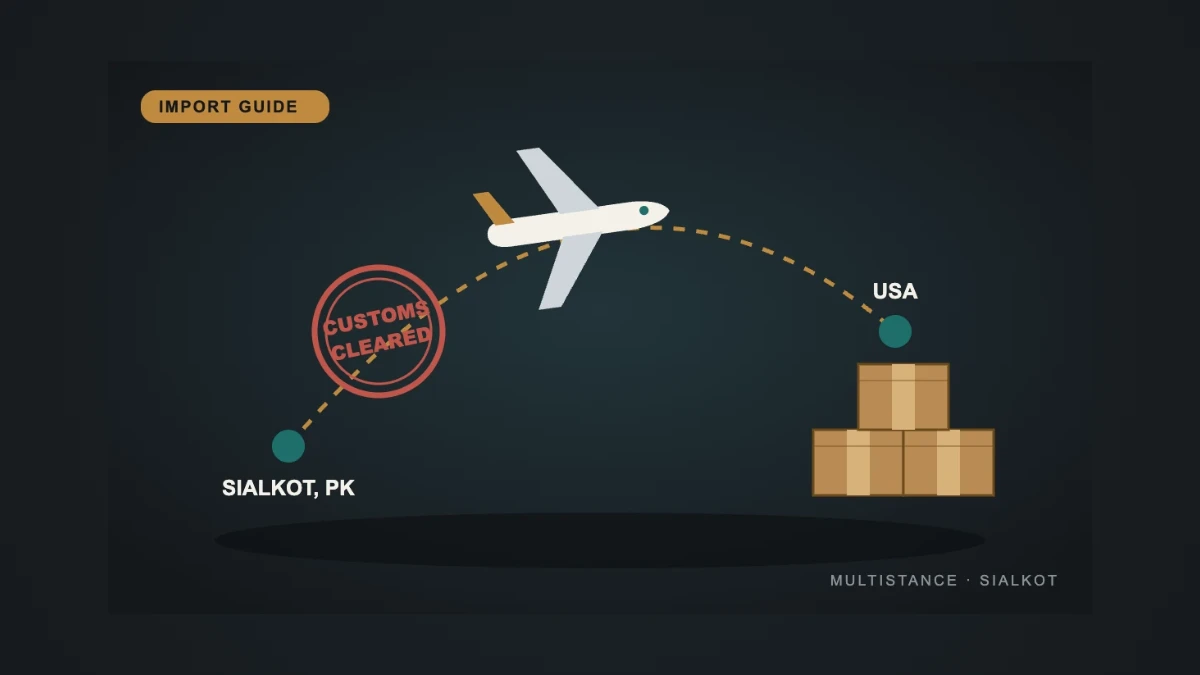
    Short answer: when you import custom uniforms from Sialkot, Pakistan to the USA, they usually travel by air express and the courier clears customs. You pay the normal US duty for the garment’s HTS code plus a 10% Section 301 tariff on Pakistani goods (in force since 24 July 2026). There is no duty-free allowance for small parcels any more, so even samples pay duty.

    This guide shows US teams, clubs and brands how to import custom uniforms step by step: the shipping options, the costs at the border and the paperwork, so nothing surprises you when the boxes arrive.

    Air express or sea freight?

    Air express (DHL, FedEx, UPS)Sea freight
    Best forTeam orders, samples, urgent re-ordersLarge brand orders, many cartons
    TransitUsually a few working daysSeveral weeks port to port, plus inland delivery
    CustomsCourier clears it for youYou need a customs broker
    CostHigher per kiloLower per kilo, but fixed port and broker charges

    Most team orders are light enough that air express is the sensible choice: it is door to door, tracked and cleared by the courier. Sea freight starts to make sense for large, regular brand orders shipped well ahead of a season.

    What you pay to import custom uniforms in 2026

    1. Normal US duty (MFN rate). Set by the garment’s HTS code. Synthetic sportswear rates vary by product; some knit tops are as high as 32%.
    2. Section 301 tariff on Pakistan. An extra 10% since 24 July 2026, added on top of the normal duty. It replaced the temporary 10% Section 122 surcharge that ran from February to July 2026.
    3. Processing fees. Merchandise processing and courier clearance or disbursement fees.

    The $800 de minimis exemption — which used to let small parcels in duty-free — has been suspended for all countries since August 2025, and the suspension continued through 2026. Plan for duty on every shipment, including a single sample.

    Tariff rules changed several times in 2025 and 2026. Before you order, ask your courier or a licensed customs broker to confirm the rate for your exact HTS code.

    Documents your shipment needs

    • Commercial invoice — buyer, seller, a clear product description (fibre content, knit or woven, garment type), quantity, value and country of origin: Pakistan.
    • Packing list — cartons, weights and contents.
    • Air waybill or bill of lading — issued by the courier or shipping line.
    • Country of origin labels — US rules require garments to be labelled with their country of origin (“Made in Pakistan”) and fibre content.

    Multistance prepares the commercial invoice, packing list and shipping documents at dispatch, and they are stored in your buyer portal with the rest of your order records. See what each order generates.

    Who pays duty: Incoterms in plain words

    Your quote states the Incoterm. Under EXW or FOB you arrange freight and pay duties. Under DAP the seller pays freight to your door and you pay duties on arrival. Under DDP the seller pays duties too. Teams new to importing often prefer DAP with an air courier, because the courier handles clearance and bills the duty. Read our full Incoterms guide for apparel importers.

    A simple checklist to import custom uniforms

    1. Agree the Incoterm and shipping method in the quote.
    2. Ask your courier or broker for the duty rate on your product codes.
    3. Confirm the delivery address and a contact who can answer customs questions.
    4. Check the commercial invoice description is specific (e.g. “men’s knitted polyester football jersey”), not just “sportswear”.
    5. Budget for duty, the 10% Section 301 tariff and fees on top of the factory price.
    6. Keep all documents for your records.

    Frequently asked questions

    Is there a tariff on clothing from Pakistan in 2026?

    Yes. Since 24 July 2026, goods from Pakistan carry an extra 10% Section 301 tariff on top of the normal US duty rate for the product.

    Can I still import small orders duty-free under $800?

    No. The US suspended de minimis duty-free treatment for all countries in August 2025, and it remained suspended in 2026.

    Do I need a customs broker to import custom uniforms?

    For air express shipments the courier usually clears customs for you. For sea freight or large commercial shipments you normally need a licensed customs broker.

    How long does shipping from Sialkot to the US take?

    Air express usually takes a few working days after dispatch. Sea freight takes several weeks plus inland delivery. Your total timeline also depends on sampling and production.

    Who handles the export paperwork in Pakistan?

    The manufacturer. Multistance prepares the commercial invoice, packing list and shipping documents and shares them in your buyer portal.

    Planning an order? See custom team uniforms for US teams, read how an order works, or request a quote.

    Checked 9 November 2026. Sources: Section 301 forced-labor tariffs, Penn Wharton Budget Model, de minimis suspension. This is general information, not customs or legal advice.

  • Milestone Payments vs 100% Upfront: How to Pay an Overseas Uniform Manufacturer Safely

    Milestone Payments vs 100% Upfront: How to Pay an Overseas Uniform Manufacturer Safely

    Short answer: for most team and brand orders, milestone payments — payments tied to verified production stages — are the safest middle ground. You never pay for work you cannot see, and the factory is funded for materials. 100% upfront puts all the risk on you; letters of credit give strong protection but cost more and suit larger orders.

    When you order sportswear from a manufacturer in Sialkot, Pakistan — or anywhere overseas — the payment terms matter as much as the price. This guide compares the common options and explains how milestone payments work in practice.

    The common payment terms compared

    Payment termHow it worksBuyer riskBest for
    100% upfrontFull payment before productionHigh — you have paid before seeing anythingSamples and very small orders only
    Deposit + balanceA deposit to start, the balance before shippingMedium — you see little until the balance is dueRepeat orders with a supplier you trust
    Milestone paymentsPayments released at defined production stages, with proof at each stageLow to medium — each payment follows visible progressFirst orders, team kits, new brands
    Letter of credit (LC)Your bank pays when shipping documents match the termsLow — but bank fees and paperworkLarge commercial orders
    Platform escrowA marketplace holds funds until deliveryLow — but platform fees and rulesOrders placed through a marketplace

    For how letters of credit work in detail, see the US International Trade Administration’s letter of credit guide.

    Why milestone payments work for both sides

    The factory needs money to buy fabric and trims; you need proof that your order is real before paying more. Milestones solve both. Each payment is linked to a stage you can check — an approved specification, photos from the production line, an inspection report — so your money follows the work.

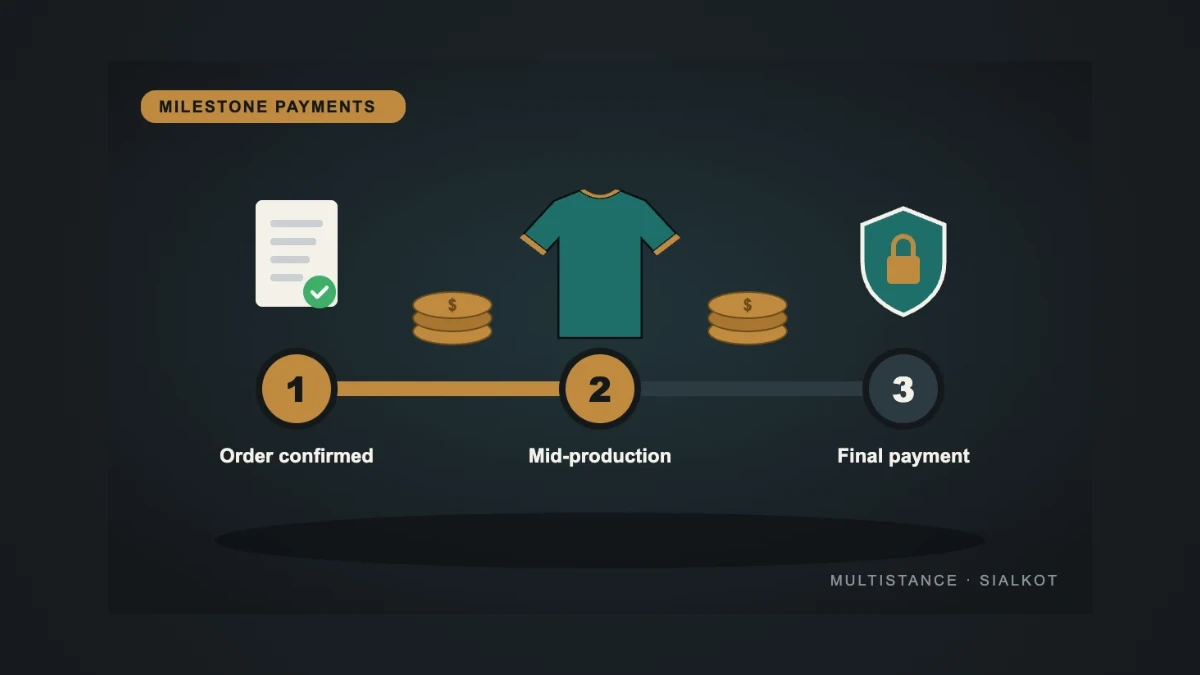
    How milestone payments work at Multistance: 3 checkpoints

    1. First payment — order confirmed. You approve the quote, artwork, sizes and roster in writing, then make the first payment. Production starts after this.
    2. Mid-production payment — during stitching. By now fabric has been inspected, panels cut and logos applied, all visible in your buyer portal.
    3. Final payment — after inspection and packing. You review the final inspection summary. The tracking number is released once the final payment is received.

    The amount of each payment is set in your quote, and every checkpoint has its own invoice. This is our internal payment process, not a regulated escrow service. See the full transparency system and the 10 production stages.

    Safe ways to send the money

    • Bank transfer (SWIFT) — best for larger payments.
    • Wise or Payoneer — pay into local USD, GBP or EUR details, usually with lower fees.
    • Card via Stripe — a secure payment link, good for samples and small orders.
    • Western Union or MoneyGram — available on request for sample payments.

    Whatever method you use, pay an account in the company’s name, and confirm any change of bank details by phone or video call — never by email alone.

    Questions to ask before you pay

    • What exactly triggers each payment?
    • What proof will I see at each stage — photos, reports, documents?
    • What happens if a defect is found at final inspection?
    • Which account will I pay, and is it in the company’s name?
    • When will I receive the tracking number and shipping documents?

    Frequently asked questions

    Is it safe to pay a manufacturer in Pakistan upfront?

    Paying 100% upfront puts all the risk on the buyer. For first orders, payments linked to visible production stages are safer.

    What are milestone payments?

    Milestone payments are released when a defined stage of production is complete and you can see proof of it, such as an approved specification, production photos or an inspection report.

    How does Multistance split payments?

    Into three checkpoints: a first payment at order confirmation, a mid-production payment during stitching and a final payment after inspection and packing. The amounts are set in your quote.

    Is Multistance’s payment process an escrow service?

    No. It is our internal payment process, with an invoice for each checkpoint and progress shown in your buyer portal. It is not a regulated escrow service.

    Which payment methods are accepted?

    Bank transfer (SWIFT), Wise, Payoneer and card via Stripe. Western Union and MoneyGram are available on request for samples.

    Questions about payment terms? Book a call or request a quote to see the checkpoints for your order.

  • How to Check a Sialkot Sportswear Manufacturer Is Real: 9 Checks Before You Pay

    How to Check a Sialkot Sportswear Manufacturer Is Real: 9 Checks Before You Pay

    Short answer: a real Sialkot sportswear manufacturer can show you its registration (Sialkot Chamber of Commerce membership and FBR tax registration), a live video walk-through of production, a physical sample made to your spec, an itemized quote, and a payment plan tied to production stages. If a supplier avoids any of these, slow down.

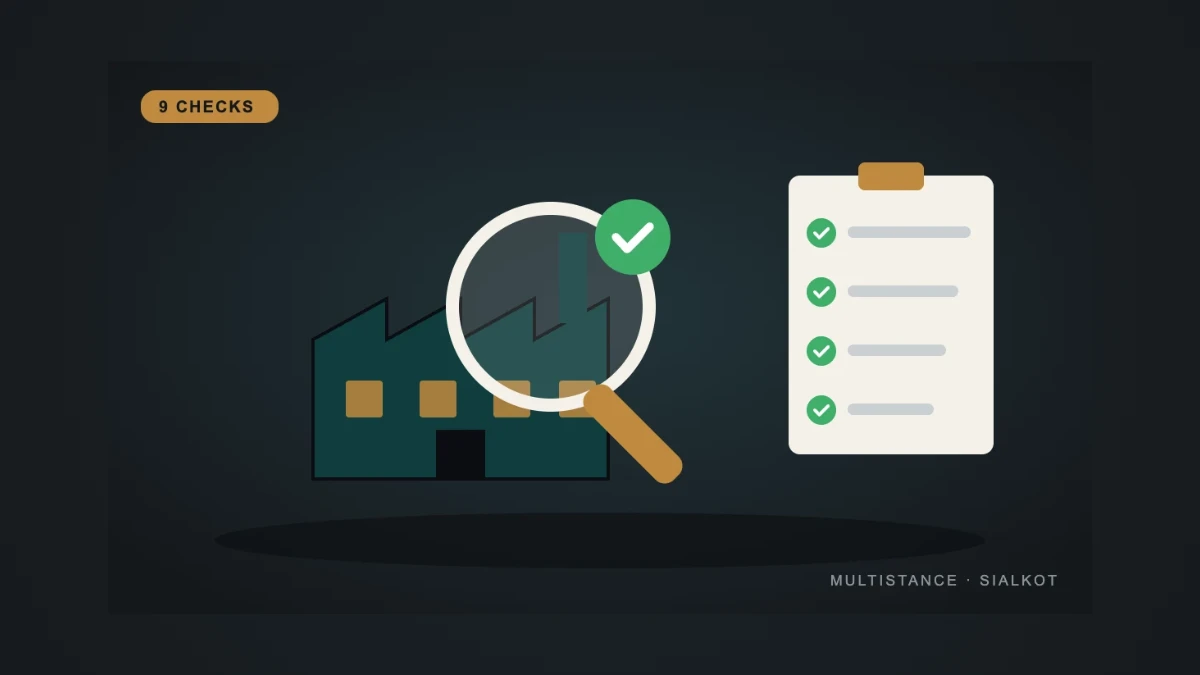
    Sialkot, in Punjab, Pakistan, is home to thousands of sportswear and sports-goods businesses. Most are genuine. But buyers also meet trading agents posing as factories, and occasionally outright scams. These nine checks take about a week and cost little. For the general version that applies to any country, see how to vet an overseas sportswear manufacturer.

    The 9 checks for any Sialkot sportswear manufacturer

    1. Business registration. Ask for the company’s Sialkot Chamber of Commerce & Industry membership and its FBR (Federal Board of Revenue) registration. Real exporters have both and share them without fuss.
    2. A consistent identity. The company name, address and phone should match across the website, invoices, Google Maps, LinkedIn and trade directories.
    3. A live video walk-through. Ask for a video call from the production floor — cutting, printing or sublimation, stitching. A pre-recorded showroom video is not the same thing.
    4. A physical sample made to your spec. Not a stock item from a shelf. Check fabric, print quality, stitching and sizing against what you asked for.
    5. An itemized quote. Fabric and weight, decoration method, sizes, names and numbers, packing, shipping terms. A one-line price is a warning sign.
    6. A written specification. Before production, the supplier should confirm artwork, sizes and quantities in writing for you to approve.
    7. Payment to a business account. Pay the company, not a personal account in another name. Be careful if bank details change by email.
    8. Staged payments. A payment plan tied to production milestones protects both sides better than 100% upfront.
    9. Documents at dispatch. Commercial invoice, packing list and tracking from a real courier or shipping line.

    Red flags when choosing a Sialkot sportswear manufacturer

    • Prices far below every other quote for the same specification.
    • No video call, or only from an office.
    • Pressure to pay everything upfront “to secure the slot”.
    • Bank account name different from the company name.
    • Photos that appear on many other suppliers’ sites (try a reverse image search).
    • Vague answers when you ask what happens if a defect is found at final inspection.

    How Multistance makes these checks easy

    As a Sialkot sportswear manufacturer, we built our process so buyers do not have to take our word for anything:

    • Multistance International is a member of the Sialkot Chamber of Commerce & Industry and registered with the FBR.
    • Every order moves through 10 documented production stages with 5 quality checks, each updated in your buyer portal with photos.
    • Payment is split into three checkpoints — first payment at order confirmation, a mid-production payment during stitching and a final payment after inspection and packing.
    • Quote, artwork, sizes and specification are approved in writing before production starts.

    Want to see it before you commit? Book a call and ask us to walk you through a live order.

    Frequently asked questions

    How do I know if a Pakistani manufacturer is legitimate?

    Check its Sialkot Chamber of Commerce membership and FBR registration, ask for a live video call from the production floor, order a sample made to your specification and pay a business account in the company’s name.

    Is it safe to buy sportswear from Sialkot?

    Yes, when you run basic checks. Sialkot is one of the world’s main centres for sportswear and sports goods. Most problems come from skipping samples, paying everything upfront or dealing with unverified agents.

    Should I pay 100% upfront?

    It is safer to split payment into stages linked to production. At Multistance payment is split into three checkpoints, and the tracking number is released after the final payment.

    How can I tell a factory from a trading agent?

    Ask for a live video of cutting, printing and stitching, and check that the company name on the invoice and bank account matches the business you are talking to.

    What documents should I receive?

    At minimum: a written specification or contract, invoices for each payment, a packing list and the shipping documents with tracking.

    Sourcing from Pakistan? Start with our sportswear manufacturer in Pakistan page or request a quote.

  • Reading a Fabric Inspection Report

    A fabric inspection report typically covers a handful of core measurements: weight (usually in GSM), width, shrinkage after washing, colorfastness, and a visual defect count per roll.

    GSM (grams per square meter) tells you how heavy or light the fabric is relative to spec — a garment that runs noticeably lighter than the approved sample often points to a fabric substitution somewhere in the supply chain.

    Shrinkage and colorfastness results matter more for how the product performs after the customer washes it than for how it looks on day one — this is often where the real quality gap between manufacturers shows up.

    A useful habit: compare the inspection report against your original approved sample’s measurements, not just against a generic industry standard. The report is most valuable as a comparison, not a standalone number.

    Have a sourcing question? Ask us or book a call.

  • Understanding Incoterms for Apparel Importers

    Incoterms define where responsibility for a shipment transfers between seller and buyer — not just who pays for freight, but who carries the risk at each stage of the journey.

    Under FOB (Free on Board), the manufacturer’s responsibility ends once goods are loaded onto the shipping vessel at the origin port — from there, the buyer (or their freight forwarder) manages the rest.

    Under CIF (Cost, Insurance, and Freight), the manufacturer arranges and pays for freight and insurance to the destination port, though risk still typically transfers once goods are loaded.

    Neither term is universally ‘better’ — the right choice depends on whether you already have a freight forwarder relationship and how much control you want over the shipping leg. What matters most is that the term is agreed in writing before production begins, not assumed.

    Have a sourcing question? Ask us or book a call.

  • What MOQ Actually Means for New Brands

    A manufacturer’s minimum order quantity isn’t an arbitrary gatekeeping number — it usually reflects a real constraint, like a minimum fabric roll length, a minimum efficient run on a particular machine, or a per-style setup cost that only makes sense above a certain volume.

    That means MOQ should vary by product, not be quoted as a single company-wide figure. A simple single-color tee has a very different minimum than a multi-panel, multi-color combat sports garment with custom trims.

    If a manufacturer quotes one flat MOQ for everything they make, it’s worth asking what’s actually driving that number for your specific product — the answer tells you whether it’s a real constraint or a soft preference for larger customers.

    For new brands, the more useful question is often: what’s the minimum for exactly what I want to build, and why?

    Have a sourcing question? Ask us or book a call.

  • OEM vs. Private Label, Explained

    The two terms get used loosely, but the practical difference is straightforward. OEM manufacturing means building a product to your specification — your tech pack, your materials, your construction requirements — regardless of whose label ends up on it.

    Private label typically starts from a proven, existing construction and adds your branding: your label, your hangtag, your packaging. It’s often a faster and lower-risk path for a new brand that doesn’t yet have a fully developed tech pack.

    Neither model is inherently better — the right choice depends on how much control you need over construction versus how quickly you need to get to market. Many brands start private label for their first collection and move toward OEM as their specifications mature.

    What shouldn’t change between the two is the discipline behind the order: the same documented process, inspection stages, and payment structure should apply either way.

    Have a sourcing question? Ask us or book a call.